
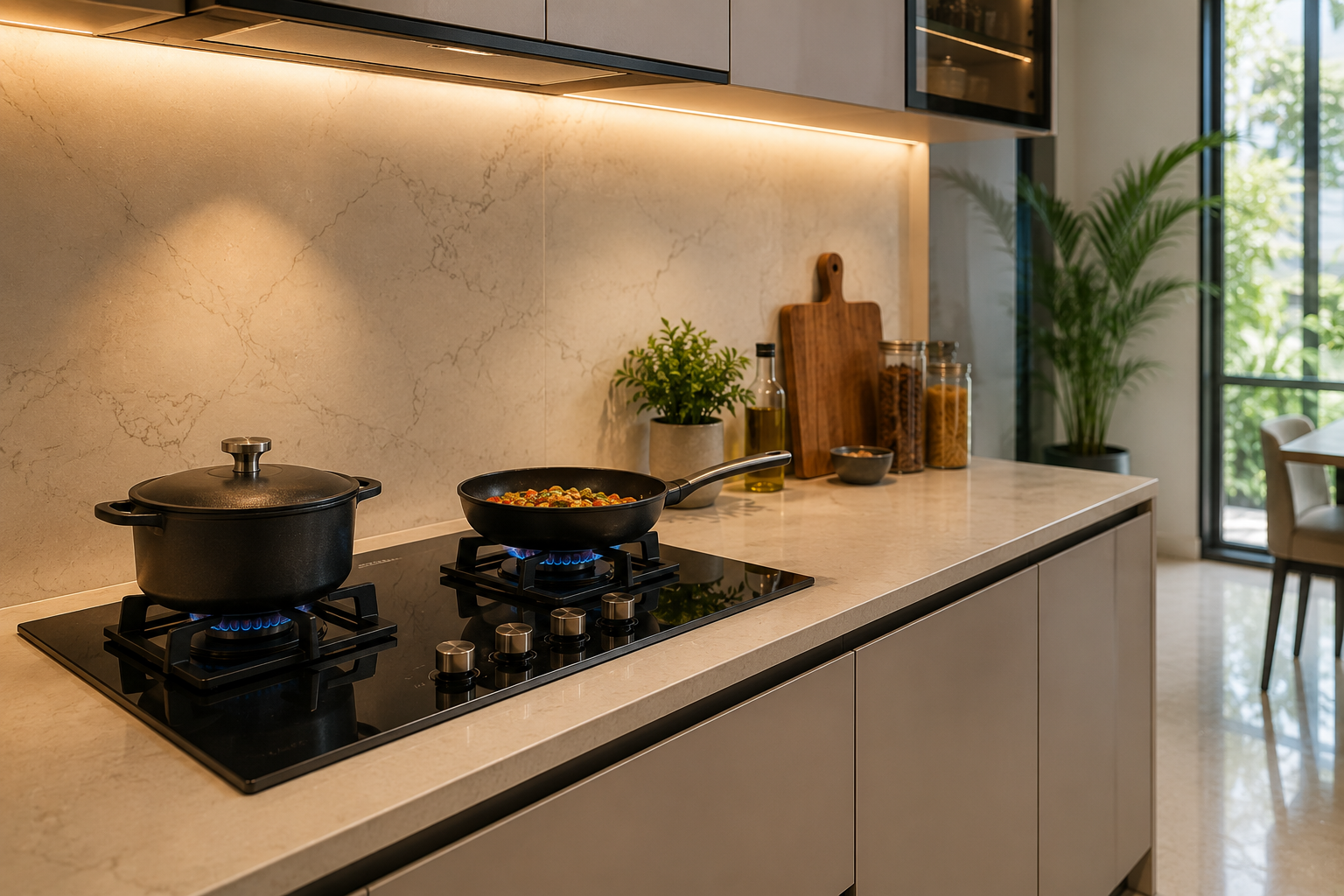
Designing a modern kitchen is an exciting journey, but it is also one filled with high-stakes decisions. If you are currently setting up a premium modular kitchen or renovating your family home in Jaipur, you have likely run into one of the most debated questions in kitchen design today: Should you install a built-in gas hob or a modern induction cooktop?
For generations, the blue flame of a gas stove has been the unquestioned heart of the Indian household. However, as Jaipur’s residential landscape shifts towards sleek high-rises in Jagatpura, luxury apartments in Malviya Nagar, and modern villas in Vaishali Nagar, kitchen aesthetics are evolving. Homeowners are caught between the tactile familiarity of cooking with fire and the clean, flush, and futuristic appeal of glass-top induction systems.
Choosing between these two technologies is not just a matter of looks; it directly dictates your daily cooking speed, safety, energy bills, and how comfortable you feel standing over the counter during Rajasthan’s intense summer months. This guide breaks down the practical realities of gas hobs versus induction cooktops to help you make an informed decision for your Jaipur home.
Why This Choice Matters in Modern Jaipur Kitchens
In a traditional kitchen, appliances were often bought as freestanding, standalone units and placed wherever there was free space on the counter. Today, Jaipur’s interior design standards are defined by seamless modular kitchens featuring flush, built-in appliances.
A built-in appliance permanently integrates into your stone countertop. This means once you cut your premium quartz or granite platform to fit a specific appliance size, changing your mind later is incredibly difficult and expensive. You cannot easily swap a built-in gas hob cut-out for an induction cooktop without replacing or heavily modifying your countertop.
Furthermore, our culinary habits are changing. While we still love our slow-simmered curries and fresh, puffed phulkas, busy dual-income households require speed, efficiency, and easy cleanup. Balancing these modern needs with traditional recipes is why this appliance choice is so critical during your layout design phase.
Gas Hob vs Induction Cooktop – What’s the Real Difference?
To make the right choice, it helps to understand the core technology behind both appliances without getting lost in technical jargon.
- Built-in Gas Hobs: These function much like traditional gas stoves but sit completely flush with your countertop. They rely on Liquid Petroleum Gas (LPG) or Piped Natural Gas (PNG) to produce an open flame. The heat from the flame transfers to your pan through the surrounding air. Because of this, a significant amount of heat (often up to 45% to 50%) escapes into the kitchen environment instead of heating the food.
- Induction Cooktops: These do away with open flames and direct heating elements entirely. Instead, they utilize high-frequency electromagnets located beneath a flat ceramic glass surface. When you place a magnetic pan (like cast iron or induction-compatible stainless steel) on the cooktop, the magnetic field directly excites the iron molecules inside the pan itself. The pan effectively becomes the heating element, while the glass surface remains relatively cool to the touch. This direct energy transfer is incredibly efficient, with up to 90% of the heat going directly into your food.
Which One Works Better for Indian Cooking (Real Jaipur Use Case)?
Indian cooking is highly diverse, demanding rapid changes in temperature, sustained high-heat searing, and flat-surface baking. How do these technologies handle our daily menu?
The Art of the Tadka
Preparing a classic tadka requires heating oil or ghee to a very high temperature and throwing in dry spices, which release volatile oils. A gas hob excels here because the open flame wraps around the curved bottom of a traditional round kadhai. On an induction cooktop, you cannot use a curved, round-bottomed pan because the electromagnetic connection requires flat-bottomed cookware to function. While flat-bottomed kadhais are widely available today, the visual cooking style of swirling spices in a tilted pan temporarily breaks the induction connection, which can be frustrating for traditional cooks.
Perfect Phulkas
If your family eats fresh rotis or phulkas daily, gas hobs have a clear advantage. Achieving that perfect balloon-like puff traditionally requires roasting the flatbread on a tawa and then holding it directly over an open flame for a few seconds. This is physically impossible on a flat induction glass surface.
Precision Simmering
This is where modern engineering bridges the gap. Traditionally, induction was preferred for its precise, digital heat settings, while gas stoves required constant manual adjustment. However, premium Bosch gas hobs now feature patented FlameSelect technology. This system provides nine distinct, pre-defined flame levels that you can click into place. This gives you the exact same digital-like precision of induction on a real gas flame, allowing you to simmer delicate gravies or boil milk without any risk of spilling over.
Why Many Jaipur Homes Still Prefer Gas Hobs
Despite the rise of induction, built-in gas hobs remain the dominant choice in Rajasthan, and for several very practical reasons:
- Traditional Cookware Compatibility: From heavy earthen clay pots (handis) used for slow-cooked curries to standard aluminum pressure cookers and cast-iron griddles, a gas hob accepts every type of material, shape, and size without complaint.
- Tactile Cooking Experience: Many home cooks gauge heat visually by looking at the height of the blue flame rather than reading a digital number on a touch panel.
- Independence from the Power Grid: Jaipur’s intense summers can occasionally put massive pressure on the electrical grid, leading to planned power maintenance cuts by JVVNL (Jaipur Vidyut Vitran Nigam Limited). Because gas hobs run entirely on LPG cylinders or PNG lines, you can cook hot meals for your family even during a power outage.
When Induction Cooktops Make More Sense
While gas hobs offer familiarity, built-in induction cooktops are rapidly gaining ground among modern Jaipur homeowners who prioritize efficiency and comfort:
- A Cooler Kitchen in Summer: Standing in a closed kitchen in Jaipur when outdoor temperatures hit 45°C can feel like standing in an oven. Because induction hobs do not release open flames or waste heat into the surrounding air, your kitchen stays remarkably cool, making cooking a far more comfortable experience.
- Incredible Speed: Induction heats cookware almost instantly. You can boil water or prepare your morning Masala Chai in nearly half the time compared to a standard gas stove.
- Effortless Cleaning: A gas hob features heavy cast-iron pan supports, brass burners, and metal drip trays that collect grease and require regular, vigorous scrubbing. An induction cooktop is a single, continuous sheet of flat ceramic glass. If milk boils over or curry spills, you simply wipe it away with a damp microfiber cloth. Because the glass surface itself doesn’t get hot, spilled food never bakes onto the surface.
Safety Comparison – Which Option is Safer for Families?
Safety is a paramount concern, especially in households with active children or elderly family members.
| Feature | Gas Hob (With FFD) | Induction Cooktop |
|---|---|---|
| Open Flame Risk | Yes | None |
| Surface Burn Risk | High | Extremely Low |
| Auto Shut-off | Yes (Gas cut-off) | Yes (Pan detection) |
| Gas Leak Hazard | Mitigated by FFD | Completely None |
Gas Hob Safety
Standard old-school gas stoves carry risks of gas leaks if the flame is accidentally blown out by a kitchen draft. Premium Bosch built-in hobs eliminate this risk entirely by integrating a Flame Failure Device (FFD). If a boiling pot of milk overflows and puts out the flame, the internal FFD sensor automatically cuts off the gas supply within seconds, preventing any hazardous buildup.
Induction Safety
Induction is naturally the safest cooking technology available. Since there is no open flame, there is zero risk of loose clothing catching fire. Additionally, because the electromagnetic field only generates heat inside the magnetic pan, the surrounding glass surface remains safe to touch. Most induction units also feature automatic pan-detection (the heat turns off the second you lift the pan) and digital child lock safety keys.
Cost Comparison – Initial Cost vs. Long-Term Usage
When planning your modular kitchen budget, you must evaluate both the upfront capital expense and the recurring operational costs.
- Initial Purchase Price: Standard high-quality built-in gas hobs generally have a lower entry price compared to multi-zone built-in induction hobs. Additionally, if you switch to induction, you may need to invest in a new set of induction-compatible cookware (cast iron or magnetic stainless steel), which adds to your initial setup cost.
- Daily Running Costs: In Jaipur, Piped Natural Gas (PNG) and LPG are highly economical fuels. While electricity is charged at standard domestic slab rates, the extreme thermal efficiency of induction (90% heat transfer versus 50% for gas) means very little energy is wasted. Consequently, the monthly operational cost of running a modern induction hob is surprisingly comparable to cooking with gas.
- Maintenance Expenses: Gas hobs have mechanical parts like spark igniters, gas valves, and brass burners that can wear out or clog over a decade of use. Induction units are solid-state electronic devices; they have fewer moving parts to maintain but can be expensive to repair if the main glass panel is cracked by dropping a heavy heavy-bottomed pot from a height.
Built-in Hob vs. Portable Induction – What Fits Modular Kitchens Better?
Many homeowners try to get the best of both worlds by installing a built-in gas hob and keeping a cheap, portable single-burner induction cooktop on the side. While this is highly functional, it can ruin the clean visual lines of a premium modular kitchen.
A portable induction cooktop sits high off the counter, takes up valuable prep space, and features a trailing black electrical cable that runs across your beautiful quartz or granite countertop.
A far more elegant, future-proof solution is to install a hybrid built-in hob or place your built-in induction flush with the countertop. This keeps your workspace completely flat, clean, and free of cluttered power cords, elevating the architectural beauty of your home.
Common Mistakes Jaipur Homeowners Make While Choosing
- Ignoring Vastu Guidelines: Vastu Shastra is highly integrated into Jaipur home designs. According to kitchen Vastu, the cooking hob must go in the South-East corner (the fire element zone), and the cook should ideally face East. Sinks (the water element) must go in the North-East. Placing your cooking hob directly next to the sink causes elemental conflict, which can easily be avoided with proper counter layout planning.
- Buying Without Testing Cookware Compatibility: Buying a premium built-in induction hob only to realize your favorite traditional copper, aluminum, or hand-made clay pots do not register on the electromagnetic sensors.
- Neglecting Electrical Infrastructure: A multi-zone built-in induction hob is a heavy-duty appliance that draws significant power (typically between 3 kW to 7 kW). Installing one requires dedicated, heavy-gauge wiring (minimum 4 sq mm) and high-load 15-Amp sockets back to your distribution board, which must be routed before your kitchen cabinetry is installed.
- Buying Online Without a Live Demo: Selecting an appliance purely based on dimensions and catalog images. You cannot judge the real-world control sensitivity of a touch panel or the exact spacing of gas burners without physically interacting with a live model.
Real-Life Jaipur Scenario – What Works for Different Households?
To make the choice easier, let’s look at two typical family structures in Jaipur’s popular residential neighborhoods :
Scenario A: The Multi-Generation Family in Mansarovar
Living in a spacious independent home, they cook three large, traditional meals daily. Their menu features rotis, slow-simmered dals, and festive deep-fried items. They have an array of traditional brass, aluminum, and clay cookware.
- Our Recommendation: A 4-burner built-in gas hob with robust brass burners and FlameSelect technology. This matches their tactile cooking habits, accepts all their cookware, and ensures they can cook uninterrupted during summer power outages.
Scenario B: The Working Professionals in Vaishali Nagar
A young couple with kids living in a modern apartment layout. They cook quick, contemporary meals, prioritize child safety, have limited time for kitchen cleanup, and want a sleek, open-concept kitchen that integrates with their living room.
- Our Recommendation: A sleek built-in induction cooktop. It keeps their kitchen cool, boils water instantly for morning rushes, is completely safe for the kids, and can be wiped pristine clean in under ten seconds.
Where to Experience Both Options Before Making a Decision
Choosing between a gas hob and an induction cooktop is not a decision you should make based on static online listings or stock photos. You need to turn the physical FlameSelect knobs, feel the heavy build quality of the brass burners, and see how quickly induction touch sensors react to your fingertips.
At Aspire Home Studio, we have built a dedicated experience center where premium Bosch gas hobs and built-in induction cooktops are fully live and operational.
We invite you to visit our New Aatish Market showroom on the main Gopalpura Bypass Road. If you are looking for a reliable products or searching for high-quality kitchen solutions, our studio is easily accessible from all central and southern residential zones.
Additionally, we regularly assist homeowners looking for a modular kitchen appliance showroom or sourcing premium built-in kitchen appliances. Our team of experts is trained to analyze your modular kitchen blueprints, evaluate your electrical load requirements, and help you select the exact configuration that matches your family’s lifestyle.
Final Recommendation – What Should You Choose for Your Home?
- Choose a Built-in Gas Hob if: You love traditional Indian cooking techniques (like flame-puffed rotis or deep-frying), prefer using standard non-induction cookware, want an intuitive visual flame-gauging experience, and need a system that runs during power cuts.
- Choose an Induction Cooktop if: You want a clean, minimalist kitchen design, want to keep your cooking space cool during hot Jaipur summers, prioritize child safety, and want the absolute fastest cooking and cleanup times.
If you are ready to stop guessing and see these premium cooking technologies in action, drop by Aspire Home Studio in Mansarovar today. Bring your kitchen measurements or stone counter plans, enjoy a warm cup of tea with our technical experts, and let us help you design the perfect, high-performance cooking space for your dream home.
If you’re planning a complete kitchen upgrade, you may also find our guide on how to design a modular kitchen. It covers everything you need to know before making your decision.