 In most Jaipur homes, a microwave oven starts its life with a very simple job: reheating yesterday’s dal, thawing frozen paranthas, or warming a glass of milk before bed. But as our daily routines become busier and kitchen designs evolve across high-rise apartments in Jagatpura and independent bungalows in Pratap Nagar, the humble microwave is being called on to do far more.
From grilling paneer tikka for weekend guests to roasting dry fruits for festive sweets and baking fresh cake batches, a good microwave can handle a massive chunk of your daily cooking. Yet, many homeowners walk away from their purchase disappointed. They buy an appliance expecting it to cook full meals, only to realize they bought a basic model that turns rotis into stiff leather and leaves cold spots in the middle of their food.
If you are setting up a new modular kitchen or upgrading your countertop appliances, choosing the right microwave requires understanding how different technologies handle Indian recipes. This guide cuts through the technical jargon to help you pick the ideal microwave for your Jaipur home.
Why Choosing the Right Microwave Matters More in Indian Kitchens
Indian cooking is complex. Unlike western cuisines that rely heavily on pre-packaged meals or simple baking, a typical Rajasthani kitchen deals with dense gravies, heavy oils, delicate dairy products, and intricate spice blends.
When you use a microwave in a Jaipur household, you aren’t just heating up soup. You might be defrosting homemade ghee, steaming dhoklas, or crisping up leftover samosas.
A cheap or incorrectly sized microwave creates four common daily frustrations:
- Uneven Heating: The edges of your curry burn while the center remains icy cold.
- Textural Ruin: Breads and phulkas lose their moisture, becoming tough and chewy within seconds.
- Difficult Cleaning: Turmeric and oil splatters bake onto cheap plastic or painted interior walls, leaving permanent yellow stains and stubborn odors.
- Capacity Bottlenecks: A small glass turntable cannot fit standard 10-inch Indian casserole dishes, forcing you to reheat meals in multiple batches.
Selecting the right unit ensures your microwave functions as an active cooking assistant rather than a gloriously overpriced food warmer.
Types of Microwave Ovens – What’s the Real Difference?
Understanding microwave types comes down to one factor: how the appliance generates and distributes heat.
Solo Microwave – Basic Usage Only
A solo microwave is the simplest variant. It uses electromagnetic waves (magnetrons) to vibrate water molecules inside food, heating it rapidly from the inside out.
- Best For: Simple reheating, boiling milk, thawing frozen items, and making basic steamed dishes.
- Limitations: It cannot grill, brown, or bake. If you try to bake a cake in a solo microwave, you will end up with a dense, rubbery sponge.
Grill Microwave – Limited Cooking Options
A grill microwave includes everything a solo model offers, plus an internal metal heating coil positioned at the top of the cavity.
- Best For: Reheating fried snacks while keeping them crispy, making open toasts, and grilling thin slices of paneer or vegetables.
- Limitations: While it browns the top of your food, it lacks a fan to circulate hot air. This means it still cannot handle proper baking or uniform roasting.
Convection Microwave – Best for Indian Cooking
A convection microwave is the ultimate multi-tasker. It combines microwave energy with a heavy-duty heating element and a dedicated fan that circulates hot air throughout the entire cavity (mimicking a traditional baking oven).
- Best For: Baking cakes, roasting tandoori items, grilling kebabs, making nankhatai, steaming snacks, and heavy daily reheating.
- Why It Wins: It allows multi-stage cooking. For example, you can microwave a potato dish to cook the inside rapidly and then automatically switch to convection mode to crisp the skin.
Which Type of Microwave is Actually Suitable for Indian Cooking?
For 85% of Jaipur households, a Convection Microwave is the only type that makes long-term sense.
Indian food requires versatile heat control. When you want to bake nankhatai or roast paneer tikka, you need the circulating hot air of a convection fan to achieve that authentic, golden-brown crust.
MICROWAVE SELECTION GUIDE:-
| Your Daily Cooking Need | Recommended Microwave Type |
|---|---|
| Only warming milk, tea & leftovers | Solo Microwave |
| Crisp reheating + making toasts | Grill Microwave |
| Baking, grilling tandoori & full cooking | Convection Microwave |
| Modular kitchen + seamless aesthetic | Built-in Convection Microwave |
When Does a Solo or Grill Model Still Work?
A solo microwave is sufficient if you already own a dedicated Oven Toaster Grill (OTG) or an air fryer and purely need a secondary machine to warm food quickly. It is also suitable for small rental flats or office pantries where actual meal preparation doesn’t happen.
However, if you want a single, compact appliance that handles baking, grilling, and reheating in one space, a convection microwave is the undisputed choice.
Features That Actually Matter (And What You Can Ignore)
When browsing appliance catalogs, it is easy to get distracted by flashy features like “200 Auto-Cook Menus” or “Wi-Fi Connectivity.” Here is what genuinely impacts your daily kitchen experience:
1. Capacity (Based on Family Size)
- 20 to 23 Liters: Suitable for bachelors, couples, or small nuclear families (2-3 members).
- 25 to 28 Liters: The sweet spot for standard Indian families (4-5 members). Fits medium-sized casserole dishes easily.
- 30 Liters & Above: Essential for large joint families or those who entertain frequently. It accommodates large baking trays and multi-tier wire racks.
2. Auto-Cook Programs (Indian Recipes)
Don’t worry about having hundreds of presets. Instead, check if the appliance features calibrated presets for staple Indian dishes—such as defrosting ghee, steaming dhokla, or making quick paneer tikka. These presets automatically adjust power levels and cooking times, preventing food from drying out.
3. Even Heating & Inverter Tech
Standard microwaves pulse their heat on and off to control temperature. Premium models feature inverter technology, which delivers a continuous, smooth stream of low heat. This prevents dairy products from curdling and ensures chocolate melts smoothly without burning.
4. Ease of Cleaning (Crucial for Indian Food)
Turmeric (haldi) and mustard oil splatters are inevitable. Look for stainless steel cavities or heavy-duty enamel coatings. Stainless steel reflects heat better for uniform cooking, doesn’t chip or rust over time, and can be wiped pristine clean with a damp microfiber cloth.
Common Mistakes Jaipur Homeowners Make While Buying Microwave Ovens
- Buying Based on Upfront Discounts Alone: Grabbing a cheap solo microwave during an online sale without realizing it cannot bake or grill.
- Underestimating the Cavity Size: Buying a 20-liter unit to save a few thousand rupees, only to realize your favorite round glass serving dish hits the interior walls and cannot rotate on the turntable.
- Ignoring Door Clearance & Hinge Direction: Installing a side-opening microwave right against a wall, making it awkward to slide heavy hot dishes in and out safely.
- Buying Without Testing the User Interface: Choosing a model with complicated digital menus that require five button presses just to warm a cup of water for 30 seconds. A simple tactile dial or one-touch quick start button is far more practical for daily family use.
Built-in vs Countertop Microwave – What Works Better in Modular Kitchens?
If you are renovating or designing a modular kitchen in Jaipur, the placement of your microwave dictates your countertop real estate.
| Feature | Countertop Microwave | Built-in Microwave |
|---|---|---|
| Space Impact | Occupies counter space | Zero counter space taken |
| Design Aesthetic | Visible wires & gaps | Flush-fit, luxury look |
| Ergonomics | Placed at counter level | Installed at eye level |
| Portability | Easy to unplug & move | Fixed inside cabinetry |
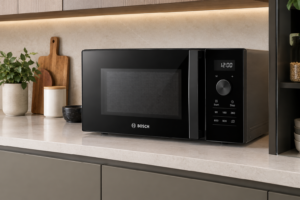
A countertop microwave sits directly on your granite or quartz counter. While flexible, it occupies precious prep space, leaves electrical cords exposed, and collects dust underneath.
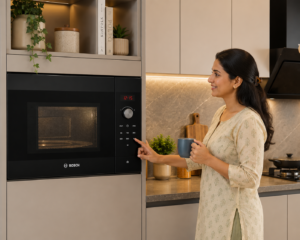
A built-in microwave integrates directly inside an overhead cabinet or a tall appliance tower. It sits flush with your modular cabinetry, hiding wires and plumbing while elevating the visual appeal of your home. Stacking a built-in microwave directly above a built-in oven creates an ergonomic, professional cooking station that keeps your countertops completely clear.
Why Bosch Microwave Ovens Are a Strong Choice for Jaipur Homes
When looking for an appliance that withstands heavy daily usage, Bosch built-in microwaves stand out for several reasons:
- Precision Inverter Technology: Delivers consistent, controlled power so your gravies heat evenly without boiling over or splashing across the interior.
- Seamless Built-in Integration: Designed to match standard 60cm European cabinetry dimensions, fitting perfectly flush alongside Bosch built-in ovens and hobs.
- Stainless Steel Interiors: High-grade metal cavities handle high thermal loads, resist grease stains, and do not peel or rust even after years of exposure to steam and spice vapors.
- Intuitive Controls: Tactile rotary selector dials and responsive touch controls make setting times and power levels effortless for every family member.
Real-Life Jaipur Use Case – How Families Use Microwave Daily
Consider a typical family living in a modern 3-BHK flat in Jagatpura:
- 7:30 AM (Morning Rush): Warm milk for the kids, quickly thaw frozen paranthas, and boil eggs in minutes.
- 2:00 PM (Lunch Prep): Reheat leftover dal and sabzi from the fridge without lighting the gas stove or dirtying extra pans.
- 6:30 PM (Evening Snacks): Crisp up tea-time snacks, melt butter for baking, or grill paneer tikka using the convection fan.
- 8:30 PM (Festive Sweets): Roast dry fruits evenly in ghee without burning them for homemade halwa.
While a microwave doesn’t replace the gas hob for puffing fresh phulkas, it effortlessly handles 40% of daily kitchen heating, prep, and defrosting tasks.
Microwave vs OTG vs Traditional Cooking – What Should You Choose?
- Choose an OTG (Oven Toaster Grill) if: You are a dedicated baker who regularly bakes large batches of artisan breads, cakes, and macarons. OTGs use heavy radiant heating rods that excel at traditional baking, but they cannot reheat liquids or thaw food quickly.
- Choose a Convection Microwave if: You want a versatile machine that reheats leftovers in 60 seconds, bakes cakes, grills snacks, and boils vegetables—all within a single compact footprint.
For 90% of modern households, a built-in convection microwave offers far better daily utility than keeping a separate OTG on the counter.
Where to Experience Microwave Ovens Before Buying in Jaipur
You shouldn’t buy a built-in kitchen appliance based solely on static website photos or flat dimensions. You need to open the door, check the weight of the turntable, inspect the interior metal quality, and see how the control interface operates in real time.
If you are exploring options, visiting an authorized Bosch showroom in New Aatish Market allows you to test fully operational Series 6 and Series 8 built-in microwaves.
Homeowners residing in eastern expansion zones can check out specialized configurations through a dedicated dealer for Bosch appliances near Jagatpura. Similarly, if you are located along the southern corridor, visiting an experience center configured for a Bosch showroom for Pratap Nagar & Sanganer Residents ensures you get expert guidance on electrical socket requirements and cabinet cut-out dimensions before your carpenter starts cutting wood.
Final Recommendation – Which Microwave Should You Buy?
- For Small Families (1-3 Members) / Basic Heating: A 20 to 23-liter Solo or Grill Microwave.
- For Standard Families (4-5 Members) / Daily All-Round Cooking: A 28-liter Convection Microwave with stainless steel cavity.
- For Modern Modular Kitchens & Luxury Homes: A 36 to 45-liter Built-in Convection Microwave stacked in an appliance tower.
Ready to upgrade your kitchen workflow? Visit Aspire Home Studio at New Aatish Market today. Bring your kitchen floor plans, enjoy a live demonstration of our built-in appliances, and let our technical experts help you choose the ideal microwave for your home!
Related Posts