
Best Kitchen Chimney for Indian Cooking in Jaipur – What Actually Works?
Step into any traditional kitchen in Jaipur during lunch hours, and your senses are instantly hit by the rich aroma of mustard oil heating up for a tadka, the sharp sting of dry red chillies hitting a hot pan, or the deep-frying sizzle of pyaaz kachoris. Indian cuisine is an art form of high heat, heavy fats, and volatile spices. However, while our palates love these intense flavors, our kitchen walls, wooden cabinetry, and lungs certainly do not.
A very common frustration for many families across Jaipur’s newer residential hubs is that despite spending a fortune on high-end modular kitchens, a sticky, yellowish layer of oil grime starts settling on premium laminate cabinets within months. Even worse, many homeowners find that despite having an exhaust system running at maximum speed, smoke still hangs in the air, drifting straight into the living area.
If you are currently planning a kitchen renovation or are simply tired of coughing your way through every meal preparation, you need an exhaust system that actually matches the unique, heavy-duty demands of an active Indian household. This guide breaks down exactly how to choose a kitchen chimney that works in the real world, bypassing the marketing jargon to focus on raw utility.
Why Most Jaipur Kitchens Struggle with Smoke & Oil (Even After Installing a Chimney)
The primary reason a kitchen ventilation setup fails isn’t always a defect in the machine itself; it is an architectural and culinary mismatch. Traditional Indian cooking relies heavily on ingredients like ghee, butter, and unrefined oils combined with dense spices. When heated, these elements create micro-droplets of airborne grease wrapped in heavy smoke.
Modern Ventilation Challenges in High-Rise Flats
In many modern apartment complexes built across Jagatpura, Mansarovar Extension, and the Gopalpura Bypass corridor, developers prioritize compact, space-optimized layouts. This often results in kitchens that are either semi-open or completely closed off with limited natural cross-ventilation.
The Illusion of Power
The typical homeowner complaint we hear at our studio is: “I bought a sleek chimney online, it makes a massive roaring sound, but the kitchen still feels suffocating when we fry paranthas.” What is happening here is a classic failure of air dynamics. If a machine lacks the correct internal engineering, the heavy oily grease coats the motor fins and filters rapidly, choking the air path. Instead of pulling smoke out, the machine simply recirculates dirty air, causing fine yellow grease particles to settle on your high-end ceiling panels and premium counter tiles.
Do You Really Need a Kitchen Chimney in Jaipur Homes?
If your daily cooking consists primarily of simple boiling, light sautéing, or preparing continental salads, you can easily get by with a standard exhaust fan. However, for a household where multiple full meals are prepped daily, an active mechanical ventilation system shifts from a luxury item to an absolute structural necessity.
The Divide: Apartments vs. Independent Homes
If you own an independent bungalow in established areas like C-Scheme or Civil Lines, you might have the advantage of high ceilings and large, traditional windows that allow smoke to escape naturally over time. But even then, the grease will eventually dull your paintwork.
In high-density apartment blocks where structural modifications are restricted, you cannot simply knock out a wall for better airflow. A high-performance hood becomes essential to catch the smoke right at the source precisely 24 to 30 inches above your cooktop before it has a chance to expand and contaminate the rest of your apartment’s indoor air quality.
Protecting Your Financial Investment
A modern modular kitchen in Jaipur requires a substantial financial commitment. High-grade marine ply and acrylic shutters can warp or swell if constantly subjected to hot steam and rising moisture from boiling dals. A proper extraction system pulls this moisture away completely, directly extending the physical lifespan of your kitchen architecture while preventing black mold from forming in hidden corners.
Types of Kitchen Chimneys – Which One Fits Your Kitchen Layout?
Before evaluating motor configurations, you must select a body type that aligns perfectly with your physical counter layout.
Wall-Mounted Chimneys (Most Common in Jaipur Homes)
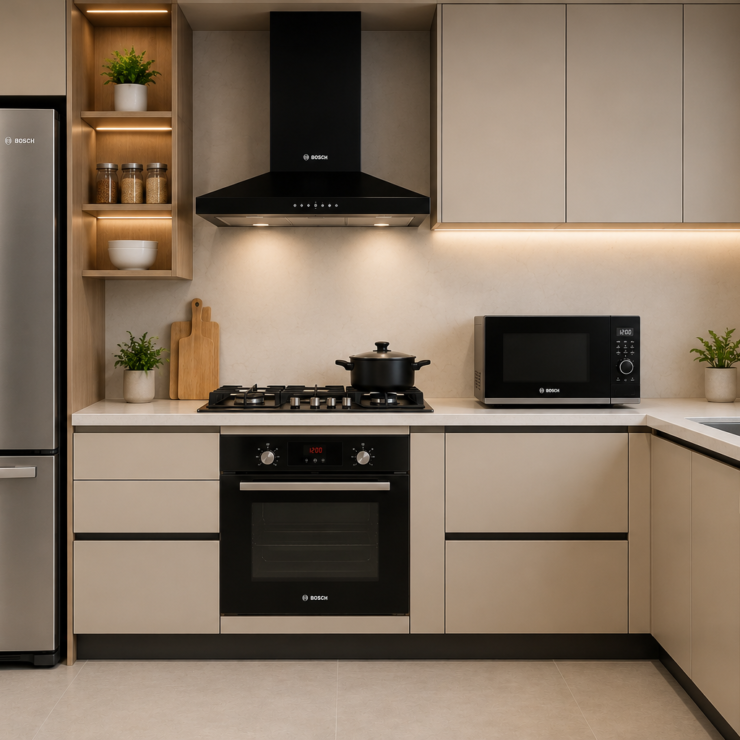
These units are fixed directly onto the wall over your stove. They work perfectly for standard kitchen designs where the cooking platform is set against a wall. If you are upgrading from a traditional setup or have a straight-line counter layout, this is your go-to design option. For those located near central residential zones, exploring options at an authorized aspire home studio can give you a clear look at how these profiles blend with standard wall cabinets.
Island Chimneys (For Premium Kitchens)
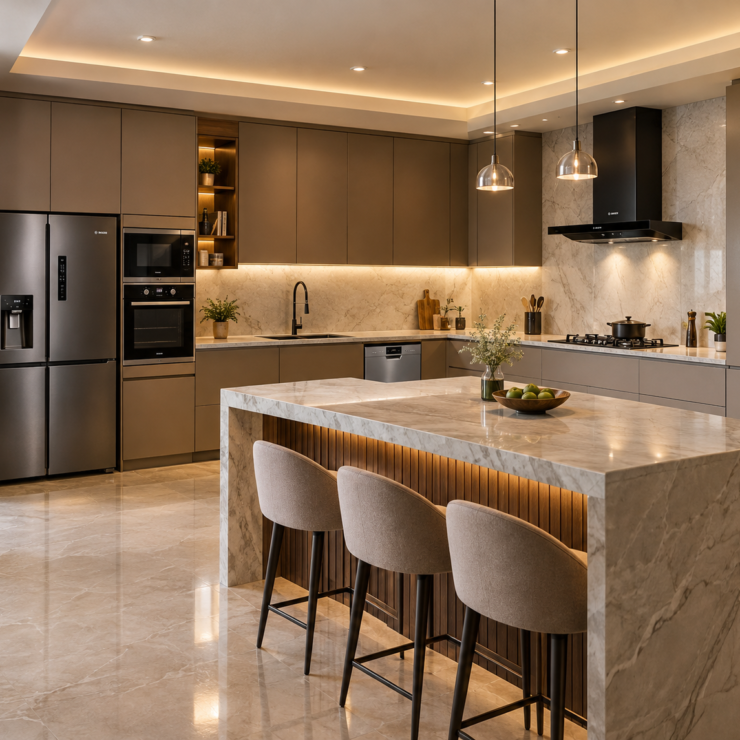
If your kitchen layout features an open-concept island platform or a breakfast counter where the hob sits right in the center of the room, you require an island chimney. These units anchor directly to the ceiling slab rather than a wall. They require a highly aesthetic finish from all four sides since they hang as a visual centerpiece in open-plan homes, a trend rapidly growing among luxury properties on Ajmer Road. For those living in the western suburbs, checking out premium layouts at an experience space for modern kitchen appliances is highly recommended to understand the ducting requirements for ceiling mounts.
Built-in Chimneys (For Modular Kitchens)
For homeowners who prefer a clean, minimalist kitchen where appliances are felt but not prominently seen, built-in or integrated telescopic hoods are ideal. These units fit seamlessly inside a standard overhead wooden cabinet box, leaving only the bottom suction panel exposed to view. This keeps the upper cabinetry completely uniform and flush.
What Suction Power Do You Actually Need for Indian Cooking in Jaipur?
Suction capacity is measured in cubic meters per hour (m³/hr or CMH). It represents the volume of air the internal motor can pull out in a sixty-minute window.
- 1000 m³/hr: Suitable only for very small kitchens (under 100 square feet) with low-frequency, light cooking habits. If you cook without heavy oil and don’t prepare deep-fried items regularly, this tier works.
- 1200 m³/hr: The baseline sweet spot for standard Indian families living in 2-3 BHK apartments. This capacity is powerful enough to handle daily multi-burner cooking, light tadkas, and routine boiling without letting fumes escape into adjoining rooms.
- 1300 to 1500 m³/hr: Recommended for large kitchens, open-floor layouts, or any household that regularly indulges in heavy frying, non-vegetarian cooking, or traditional festive cooking involving large cauldrons (kadhais).
Our practical recommendation for Jaipur residential properties is to never settle for anything below 1200 m³/hr if your daily menu involves deep-seated spices and regular oil tempering.
Key Features That Actually Matter (And What You Can Ignore)
When shopping for an appliance, it is easy to get distracted by flashy digital additions. Here is a realistic look at what actively impacts performance versus what is simply a marketing gimmick.
Suction Power – Most Critical Factor
As established, raw air movement capacity dictates how fast smoke is removed from your home. Always verify that the motor wattage (typically between 148W to 180W for premium brands) matches the claimed air delivery specs.
Filter Type – Baffle vs. Filterless
Traditional chimneys utilize stainless steel Baffle Filters, which feature overlapping curved panels. As heavy smoke passes through these curves, the oil droplets are abruptly forced to change direction, causing them to separate from the air and stick to the metal slats. While highly efficient at trapping grease, baffle filters require rigorous cleaning with warm soapy water every fortnight to prevent the mesh from choking and reducing suction.
Filterless Technology, on the other hand, does away with physical mesh screens entirely. Instead, it utilizes an isolated, highly sealed smart motor positioned further back. The airflow design creates a powerful centrifugal force that drives the heavy grease out of the air stream and deposits it directly into a rear collection cup. This maintains a completely clear air path, meaning your suction remains consistent day after day without manual scrubbing.
Auto-Clean Technology – Time-Saving Benefit
For busy households, a Heat Auto-Clean function is incredibly practical. With the single press of a touch panel or a simple hand gesture, an internal heating element warms the housing around the motor casing. This liquefies any hardened, sticky grease buildup, allowing it to drain cleanly down into a detachable oil collector tray that you can easily slide out, rinse, and snap back into place once a month.
Noise Levels – What is Acceptable?
A loud, roaring machine ruins the experience of cooking and makes it impossible to converse with family members. Standard entry-level chimneys often generate noise levels well over 70 dB, which can feel quite deafening over an hour of cooking. Premium European engineering focuses heavily on minimizing acoustic disturbance. Advanced models equipped with brushless motors or optimized insulation keep operation smooth and quiet, sitting comfortably between 55 to 67 dB even on higher speed settings.
Why Many Chimneys Fail in Indian Kitchens (Common Buying Mistakes)
- Wrong Size Selection: Installing a narrow 60 cm chimney over a wide 4-burner cooktop. The physical hood must always match or exceed the width of your stove (e.g., use a 90 cm chimney for a 3-to-5 burner stove) to ensure smoke rising from the side burners doesn’t escape past the suction zone.
- Poor Ducting Installation: Using flexible aluminum pipes with too many sharp bends or extending the pipe length beyond 10-12 feet. Every 90-degree turn drastically drops air pressure and increases operational noise.
- Buying Without a Live Demo: Selecting an extraction unit based solely on static website specifications or stock images. You cannot judge real-world motor noise or evaluate tactile build quality without physically interacting with an active model.
Why Bosch Chimneys Perform Better in Jaipur Kitchens
Bosch has successfully adapted its legendary German engineering precision to solve the specific structural pain points of the Indian culinary environment.
- Smart Motor Technology: Bosch models use robust, high-performance motors constructed with copper winding for long-term thermal durability, ensuring they maintain maximum suction capacity even under constant exposure to heavy spice vapors.
- EcoSilence Drive: Selected premium units are driven by permanent magnets instead of carbon brushes. This eliminates mechanical friction entirely, allowing the machine to pull massive air volumes while running remarkably quiet.
- Gesture Control & Touchless Interface: When your hands are covered in flour dough or oil grease, touching a glass panel leaves messy smudges. Bosch’s touchless motion sensors allow you to increase fan speeds or activate the 3-minute Delay Shut-Off mode with a simple wave of your hand.
- Official Localized Peace of Mind: Every unit comes backed by a comprehensive official 2-year product warranty alongside an extended 8-year warranty on the blower motor, supported directly by local certified service professionals across Rajasthan.
Real-Life Jaipur Use Case – What Works in Daily Cooking?
Let’s trace a typical household scenario in an upscale apartment neighborhood. For families looking to upgrade, visiting aspire home studio will show you how these units perform under load.
Imagine preparing a traditional Rajasthani dinner involving Dal, Baati, and Churma. The process requires melting substantial amounts of ghee and deep-frying dough balls. Without an optimized 90 cm filterless auto-clean unit running, hot oil vapors rapidly mix with the room air, creating a heavy, stagnant mist that settles into fabrics and curtains.
With a Bosch Series 4 or Series 6 wall-mounted unit running on Speed 3, the heavy smoke is pulled immediately into the non-return airflow flap before it can expand into your dining area. Once the cooking is complete, hitting the gesture-controlled delay timer ensures the machine continues to refresh the ambient air for another 180 seconds to clear out lingering odors completely before turning itself off automatically.
Kitchen Chimney vs. No Chimney – What Difference Will You Actually Notice?
| Feature | Without a Proper Chimney | With an Optimized Bosch Chimney |
| Cabinet Upkeep | Requires weekly wiping down with heavy chemical degreasers to remove sticky residue. | Requires a simple exterior microfiber wipe once a month; laminates retain their factory sheen. |
| Indoor Air Quality | Pungent spice odors hang in bedroom curtains and sofa fabrics for hours post-cooking. | Air remains completely fresh; smoke and fine particulate matter are evacuated within minutes. |
| Ceiling Discoloration | Kitchen ceilings develop permanent yellow or dark patches directly above the stove area. | Ceilings stay immaculate, preserving expensive interior paint and false-ceiling work. |
Where to Experience Kitchen Chimneys Before Buying in Jaipur
You should never buy a major kitchen appliance blindly based on a spec sheet. To truly understand what you are bringing into your home, you need to feel the raw suction power, hear the operational noise level with your own ears, and try out the gesture control settings yourself.
At our dedicated New Aatish Market showroom, we have created a live experience center where premium Bosch chimneys are fully mounted and operational. Homeowners visiting from nearby southern corridors can easily explore options near Mansarovar or stop by our primary hub right on the Gopalpura Bypass road. Our team is trained to evaluate your physical kitchen layout and recommend ducting pathways before you spend a single rupee.
Final Recommendation – Which Chimney Should You Choose?
- For Compact Kitchens (2-3 Burner Stoves): Go for a 60 cm Wall-Mounted Filterless model with a minimum baseline of 1250 m³/hr suction capacity. It offers the ideal balance of space saving and heavy grease management.
- For Medium-to-Large Modular Layouts (3-5 Burner Stoves): Choose a 90 cm Auto-Clean Glass model delivering 1300 m³/hr suction power. The wider footprint ensures total coverage for multiple heavy pots running simultaneously.
Ready to transform your daily cooking experience? Drop by Aspire Home Studio at New Aatish Market, Mansarovar today for a personalized layout consultation and a live hands-on demonstration with our appliance experts.
Related Posts