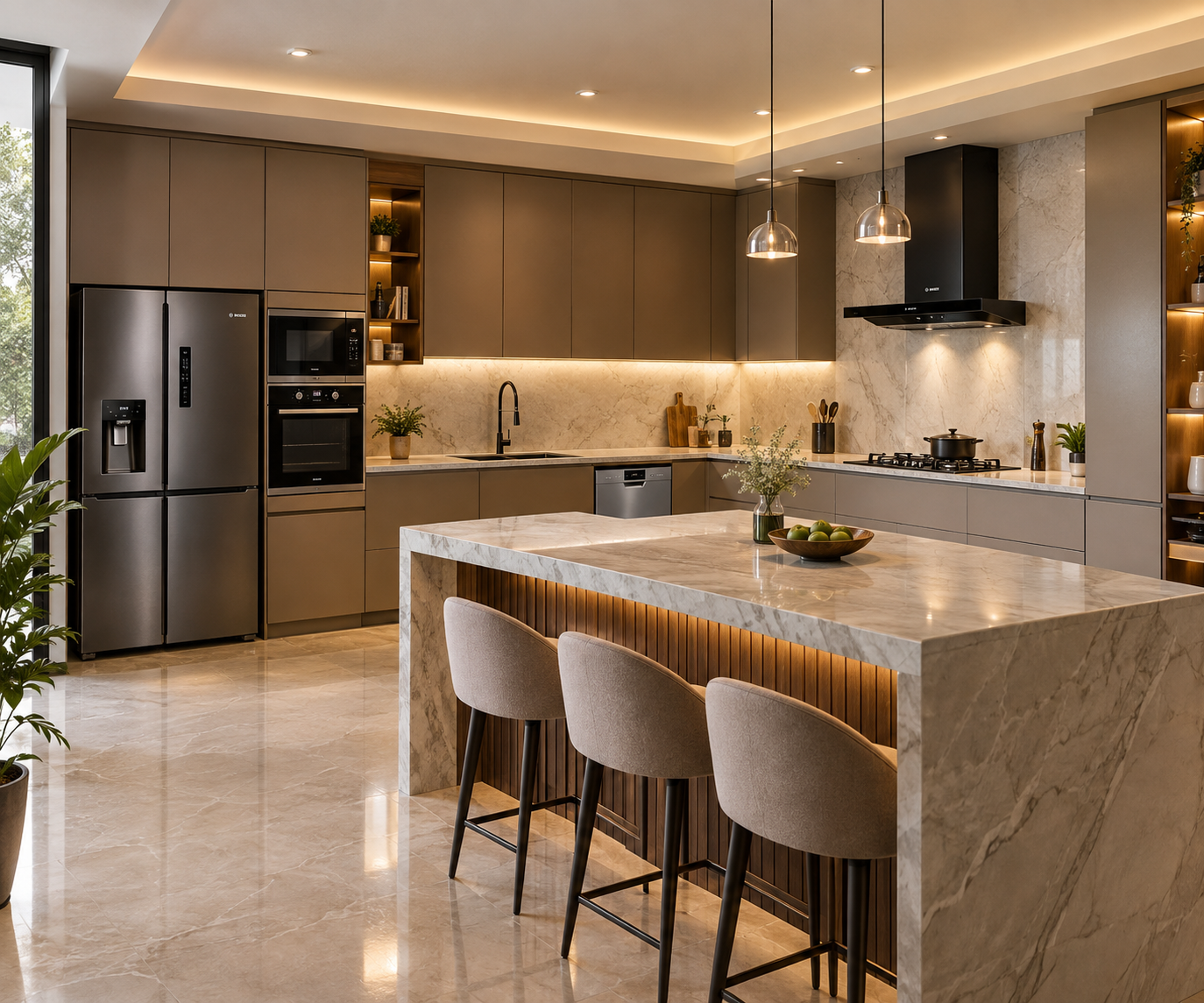
This guide explains modular kitchen appliance cut-out specifications: what a cut-out is, how it differs from an appliance’s overall size, and what to check for each built-in appliance before a single panel is cut.
One rule applies throughout. Dimensions in this guide are typical or common ranges meant for early planning. Cut-out sizes, clearances and ventilation needs change from brand to brand and model to model. The manufacturer’s installation drawing for your exact model always overrides any generic figure, including the ones here.
What Is an Appliance Cut-Out?
An appliance cut-out is the opening (in a cabinet, tall unit or countertop) that an appliance is built into. It is sized from the manufacturer’s installation drawing, not from the appliance’s outer dimensions.
Four terms are often mixed up:
•Overall dimensions: the external width, height and depth of the appliance, including the front panel or trim.
•Cut-out or niche dimensions: the internal opening the appliance body fits into. These can be smaller than the overall size (a hob’s flange rests on the counter) or larger (an appliance that needs side gaps).
•Installation clearance: the extra space required around the appliance for door swing, handles, cables, hoses or hot surfaces.
•Ventilation space: the gaps, slots or air paths the appliance needs to release heat or draw in air.
Confusing these is the root of most fabrication errors. A “60 cm oven” describes the product class, not the opening it needs.
Key Measurements You Need Before Designing the Kitchen
Before finalising a layout, collect these details for every appliance:
•Width, height and depth of the appliance and of its niche.
•Cabinet internal dimensions. Panel thickness reduces the usable opening. A 600 mm carcass is not a 600 mm opening.
•Countertop thickness. It affects hob cut-outs, under-counter dishwasher height and the space below the counter.
•Ventilation gaps at the back, sides, top or bottom, as the manufacturer specifies.
•Door-opening clearance. Ovens, dishwashers and fridges all need room to open fully.
•Electrical connection point: where the socket or connection unit sits and how the cable reaches it.
•Plumbing connections: water inlet and drain positions for dishwashers (and fridges with water lines).
•Ducting: duct diameter, route length and the number of bends for chimneys.
Modular Kitchen Appliance Cut-Out Specifications by Appliance
Built-in ovens commonly come in a 60 cm width class, with larger formats (such as 70 to 90 cm) available from some brands. They are installed in a tall unit or under the counter.
What to check:
•Niche dimensions: Many 60 cm ovens need a niche of roughly 560 mm wide, though height and depth vary by model. Treat this as a planning figure, not a specification.
•Cabinet depth: The oven body, rear cable space and door hinge area all need to fit. Shallow cabinets can leave no room behind the oven.
•Ventilation: Ovens release heat and usually need air gaps, often at the rear, top or through slots below. The required openings are model-specific.
•Electrical connection: Ovens draw significant power, and many need a dedicated supply. Socket position matters: a socket directly behind the oven can prevent it from sliding fully in.
•Clearance: Leave room for the door to open and for adjacent units to stay clear of heat.
The model’s installation drawing tells you the exact niche size, the ventilation openings and where connections may sit. Follow it, not a generic “60 cm oven cut-out.”
What is the standard size of a built-in oven cut-out? There is no single standard. Many 60 cm-class ovens use a niche of around 560 mm in width, but height, depth and ventilation requirements differ between models. Always use the manufacturer’s installation drawing.
Built-in microwaves are usually installed in a tall unit, either as a stand-alone niche or stacked with an oven.
What to check:
•Installation format: Compact built-in microwaves and larger models have different niche sizes. Some are designed for a specific frame or trim kit.
•Niche dimensions: These depend heavily on the model, especially height and depth.
•Ventilation: Many microwaves need rear or top gaps for cooling. Never assume a tight fit is acceptable.
•Clearance: Check door swing, handle clearance and the space to the shelf above and below.
•Stacking with an oven: If the microwave sits above an oven, the manufacturer may specify a divider, gap or shelf strength. Verify this in the drawings for both models.
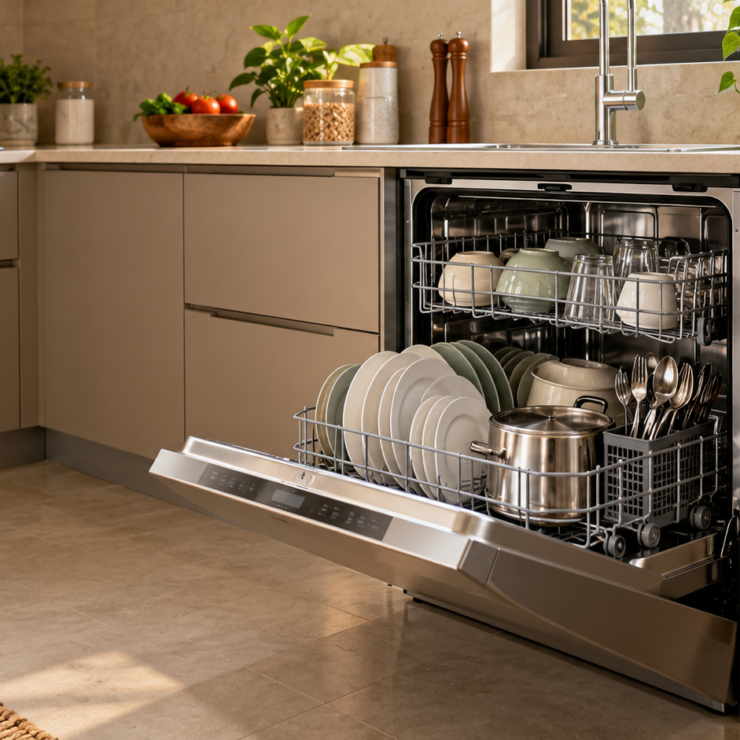
Dishwashers come in standard 60 cm and slim 45 cm widths, and a few other formats exist. They are usually slid into a gap between cabinets under the countertop.
What to check:
•Height: Many dishwashers have adjustable feet, giving a height range. The space under your countertop (after accounting for plinth and counter thickness) must fall within the model’s stated range.
•Depth: The niche must accommodate the body, hoses and door movement. The front panel and handle often add to the depth.
•Plumbing: A water inlet and a drain connection are needed nearby, usually shared with the sink area. Leave routing space; don’t rely on the dishwasher niche alone.
•Electrical: The socket should sit where it can be reached for servicing, often in the adjacent cabinet, not directly behind the appliance unless the drawing allows it.
•Door clearance: The open door and pulled-out racks need floor space and shouldn’t clash with drawers, handles or a perpendicular counter.
•Adjacent cabinets: Side panels, fixing points and any required gaps should follow the installation guide.
What size opening is needed for a dishwasher? Standard dishwashers are commonly about 60 cm wide and slim ones about 45 cm, but the exact opening height, width and depth vary by model and by how the appliance is fixed. Check the installation drawing for your model.
Built-In Refrigerator
Refrigerators are either integrated (built into a cabinet, often with a matching door panel) or freestanding (placed in a gap or against a wall). The two are planned very differently.
What to check:
•Niche dimensions: Integrated units are made for specific niche heights and widths. These vary widely by model.
•Ventilation: Refrigerators dissipate heat and need airflow, commonly above, behind or below the unit. Blocking these spaces reduces performance and can shorten the appliance’s life.
•Door swing: Check whether the door opens against a wall, a tall unit or another door. Hinge type and side matter, and some models allow reversal.
•Side, rear and top clearance: For freestanding units, leave the gaps the manufacturer specifies, particularly for door opening and for drawers to pull out fully.
•Manufacturer specifications: Integrated fridges especially depend on model-specific niche and door-fixing instructions.
Hobs are commonly available in about 60 cm, 75 cm and 90 cm widths, in gas, induction or electric versions.
Hob dimensions and countertop cut-out are different. The hob is larger than the opening: its outer edge rests on the counter, while the body sits in the cut-out. A 60 cm hob might need a cut-out noticeably smaller than 60 cm, and the exact figure depends on the model.
What to check:
•Countertop cut-out: Use the template or drawing supplied with the hob. Check the corner radius, since sharp corners on stone can crack.
•Countertop thickness: Some hobs specify a minimum and maximum thickness range for fixing.
•Clearance below the hob: The underside has burners, wiring or electronics that need space. Cabinets and drawers directly below may need a specified gap.
•Induction and electric hobs: Check ventilation needs below the hob, cable routing and the power supply requirement.
•Gas hobs: Check the position of the gas connection and keep it accessible for a qualified technician.
•Drawer or cabinet restrictions: Some hobs restrict what can sit directly beneath. Follow the installation drawing.
What is the standard hob cut-out size? There isn’t one. A hob’s cut-out depends on the brand and model, and it is smaller than the hob itself. Use the cut-out template supplied for your model.
Chimney / Range Hood
Chimneys and hoods are commonly available in about 60 cm, 75 cm and 90 cm widths, often matched to the hob.
What to check:
•Cabinet integration: Some hoods are wall-mounted, some built into a cabinet or canopy, and some are ceiling-mounted. Each has a different fixing requirement.
•Ducting: Ducted hoods vent outside. The duct diameter is model-specific, and 100 mm, 120 mm and 150 mm are commonly seen, but confirm your model’s figure.
•Duct route: Shorter, straighter ducts perform better. Long runs and many bends reduce airflow.
•Distance between hob and chimney: Manufacturers specify a recommended mounting height, and it often differs between gas and electric or induction hobs. Follow your hood’s manual.
•Ventilation and airflow: Make sure the duct outlet isn’t obstructed and that make-up air can enter the kitchen.
•Recirculating vs ducted: Recirculating hoods filter and return air to the kitchen and don’t need an outlet. Ducted hoods push air outside. Each has different space and maintenance needs.
How much clearance does a kitchen chimney need? The required distance between the hob and the chimney depends on the hood model and the hob type. Manufacturers give a recommended range in the installation manual, so use that rather than a generic figure.
Quick Cut-Out Dimension Reference Table
Note: All figures are approximate or common ranges for early planning. Exact manufacturer specifications always take precedence.
Appliance Cut-Out vs Cabinet Opening: What’s the Difference?
Appliance cut-out dimensions differ from appliance dimensions because the opening has to accommodate fixings, clearances, ventilation and the way the appliance is mounted, not just its outer body.
Here is a simple, hypothetical example to show the logic (not a real model):
• An oven is described as “60 cm.” Its front panel measures about 595 mm across.
• Its installation drawing calls for a niche width of, say, 560 mm, with a gap at the back for air.
• Your cabinet carcass is built from 18 mm panels. A 600 mm outer carcass leaves roughly 564 mm inside, so the niche is very close to what the appliance needs.
In this made-up case, working from “600 mm” alone could go wrong in either direction. The opening might be too tight for the oven body, or too loose for the trim frame to cover the gap. The point is that the cabinet’s external width, the internal opening and the appliance’s front panel are three different numbers. Only the model’s installation drawing tells you which one matters.
Electrical, Plumbing and Ventilation Requirements
Electrical sockets and cable routing
• Plan socket positions before the cabinets are built, and check them against the drawing.
• Avoid placing sockets where they block the appliance from sliding in.
• Make sure cables have a route that isn’t pinched by panels or hot surfaces.
Dedicated circuits
• Some appliances, such as ovens and induction hobs, may need a dedicated circuit or a specific rating. Have a qualified electrician confirm this. Don’t decide it from a generic guide.
Dishwasher water inlet and drain
• Plan the inlet and drain routes with your plumber, keeping hoses free of kinks and sharp bends.
• Leave room to service the connections.
Gas connections
•Gas installation should be done by a qualified technician.
•Keep the shut-off accessible, don’t enclose gas connections in a way that traps gas, and follow local safety norms.
Chimney ducting
• Confirm duct size and route with your installer before finalising wall and ceiling details.
Ventilation openings
• If a drawing calls for a vent, slot or gap, it is there for a reason. Don’t close it for the sake of a neater design.
Accessibility for servicing
• Appliances eventually need repair or replacement. Try to make sockets, isolators and connections reachable without dismantling cabinetry.
Common Modular Kitchen Appliance Cut-Out Mistakes
1. Designing cabinets before selecting appliances. The layout should follow the appliances, not the other way round.
2. Using appliance dimensions instead of installation dimensions. The outer size isn’t the niche size.
3. Ignoring ventilation. Blocked airflow leads to overheating and reduced performance.
4. Forgetting door-opening clearance. Doors that collide with handles, drawers or walls are a frequent and costly error.
5. Incorrect countertop cut-outs. Cutting a hob opening from the hob’s outer size instead of the template.
6. Poor socket placement. Sockets behind or under the appliance that prevent it from fitting.
7. Not leaving plumbing space. Dishwasher hoses need a route.
8. Not checking ducting requirements. A chimney with no practical route to outside air performs poorly.
9. Assuming all appliances of the same width have identical cut-outs. Two 60 cm ovens from different brands can need different niches.
10. Fabricating cabinets without checking the manufacturer’s installation drawing. This is the mistake that causes most of the others.
10. Fabricating cabinets without checking the manufacturer’s installation drawing. This is the mistake that causes most of the others.
How to Measure for a Modular Kitchen Appliance
1. Select the exact appliance model. Use the full model number, not a size category.
2. Find the manufacturer’s installation or specification sheet. It is usually available from the brand’s website or supplied with the appliance.
3. Record overall dimensions. These help with layout and door clearance.
4. Record niche or cut-out dimensions. Note tolerances if given.
5. Check required clearances. Include side, rear, top and door-opening space.
6. Check ventilation. Note any required openings or gaps.
7. Check electrical and plumbing requirements. Confirm positions with a qualified electrician or plumber.
8. Confirm cabinet dimensions. Subtract panel thickness to get the true internal opening.
9. Recheck everything before fabrication. A second person reviewing the numbers catches many errors.
Conclusion
Getting modular kitchen appliance cut-out specifications right is what separates a kitchen that fits from one that needs rework. The overall size of an appliance, its niche, the clearances around it and the ventilation it needs are four separate things, and each can affect the cabinet design.
Typical dimensions are useful for early planning, but they are only a starting point. Before any cabinet is fabricated, pick the exact model, get its installation drawing and build to that. When in doubt, the manufacturer’s specification wins.
Frequently Asked Questions
1. What is an appliance cut-out?
It is the opening in a cabinet or countertop that a built-in appliance fits into. It is defined by the manufacturer’s installation drawing.
2. Why are appliance cut-out dimensions different from appliance dimensions?
The opening has to allow for fixing method, ventilation, clearances and, in the case of hobs, the rim that rests on the counter. So it is often different from the appliance’s outer size.
3. What is the standard size of a built-in oven cut-out?
There’s no universal standard. Many 60 cm-class ovens use a niche around 560 mm wide, but height, depth and ventilation vary. Follow your model’s drawing.
4. What size opening is needed for a dishwasher?
Standard models are commonly about 60 cm wide and slim ones about 45 cm, but the exact opening depends on the model. Check the installation sheet.
5. How much clearance does a kitchen chimney need?
The recommended hob-to-chimney distance varies by model and by hob type. Use the range stated in the chimney’s manual.
6. Can I build the cabinets first and buy appliances later?
It is risky. Appliance specifications vary, so cabinets built without a chosen model may not fit. If you must, leave adjustable allowances and confirm before fabrication.
7. Do two 60 cm hobs have the same countertop cut-out?
Not necessarily. Cut-outs differ by brand and model. Use the template supplied with your hob.
8. Should the chimney be ducted or recirculating?
Ducted hoods vent air outside and suit kitchens where a duct route is possible. Recirculating hoods filter and return air, which suits places without one. Your chimney model and kitchen layout decide which is practical.
Related Posts