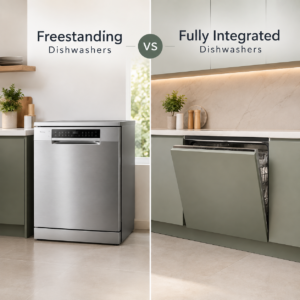
Most dishwashers do the same job: clean, rinse and dry your dishes. What differs is how they fit into the kitchen. Dishwashers generally come in two formats, freestanding and fully integrated, and the one you choose affects how your kitchen looks, how it is planned and how easily the appliance can be replaced later.
The freestanding vs. integrated dishwasher question is easier to settle early, ideally before cabinetry is ordered. This guide explains how each type works, where they differ, and what to check before you buy.
1. What Is a Freestanding Dishwasher?
A freestanding dishwasher is a complete, finished appliance. It has its own front, sides and top, so it looks presentable whether it stands alone or sits between cabinets.
How it is installed: It is positioned in a gap in the kitchen layout and connected to the water supply, drain and electricity. Some models can also fit under a counter, but this depends on the model, so check the manufacturer’s specifications.
What you see: The whole front of the appliance, including its door, handle and control panel, stays visible. Finishes vary by model.
Placement flexibility: A freestanding unit does not need to be built into a cabinet run. This can help when a kitchen is already finished, when space is limited, or when the layout may change in future.
When it may suit you:
- You are adding a dishwasher to an existing kitchen
- You want a simpler installation with fewer cabinet changes
- You may move or replace the appliance later
- You do not need every appliance hidden behind cabinet fronts
2. What Is a Fully Integrated Dishwasher?
A fully integrated dishwasher (often called a built-in dishwasher) is designed to sit inside a cabinet run. A front panel matching your cabinet doors is fixed to the dishwasher door, so the appliance blends into the surrounding units.
Controls: On most fully integrated models, the controls sit on the top edge of the door. They are hidden when the door is closed and visible when you open it. Check how each model displays its cycle status, because some use indicators or projected lights, and this varies by brand.
Semi-integrated models: Some dishwashers fall between the two types. They have a matching door panel but a visible control strip at the front. If you are comparing models, check which category a product belongs to.
Why it creates a seamless look: With no visible appliance front, the cabinetry reads as one continuous surface. That matters in fitted kitchens where handles, finishes and lines are planned carefully.
Why planning matters: The dishwasher and the cabinet work together. The cabinet opening, the door panel’s size and weight, the hinge or fixing method and the plinth height must all match the dishwasher’s specifications. These requirements differ by model and manufacturer, which is why a fully integrated dishwasher should be chosen before the cabinetry is finalised.
3. Freestanding vs. Fully Integrated Dishwasher: Key Differences
| Feature | Freestanding | Fully Integrated |
|---|---|---|
| Appearance | Appliance front is visible | Hidden behind a matching cabinet panel |
| Installation | Positioned in a space, then connected | Fitted into a cabinet opening, with the panel attached |
| Cabinet integration | Not required, though some models can go under a counter | Built into the cabinet run |
| Flexibility | Easier to place, move or relocate | Fixed within planned cabinetry |
| Controls | Usually on the front panel | Usually on the top edge of the door, hidden when closed |
| Replacement | Often simpler if the new unit has a similar footprint | May need panel and fixing adjustments, depending on the model |
| Kitchen planning | Can be chosen late in the process | Best planned alongside the cabinetry |
| Design suitability | Works with many layouts and existing kitchens | Suits fitted kitchens focused on visual continuity |
Neither format is inherently better in energy use, noise, durability or cleaning performance. Those depend on the specific model, so compare specifications rather than assuming a type will perform better.
4. Installation Differences
Both types need water, drainage and power, and the basics are similar. The differences lie mostly in how the appliance relates to the cabinetry. Exact dimensions and installation requirements vary by model and manufacturer, so treat the points below as things to check, not fixed rules.
Available space
A freestanding unit needs a gap that fits its width, height and depth, plus room to access the connections. A fully integrated unit needs a cabinet opening sized to the manufacturer’s instructions, often with specific tolerances.
Plumbing and drain connection
Both types need a water inlet and a drain outlet. In a fitted kitchen, these connections are usually planned in advance, often inside the adjacent sink cabinet. For an existing kitchen, check whether supply and drain points are close enough and whether hose lengths work for the model you want. Water quality is also worth considering: if your supply is hard, our guide to the best dishwasher for hard water in Jaipur covers what to look for.
Electrical connection
A dishwasher needs a suitable power supply. Check the socket position, the rating and whether it can be reached when the appliance is in place. Follow the manufacturer’s guidance, and have a qualified electrician confirm any wiring questions.
Door clearance
Dishwasher doors swing down and out, so you need room to open the door fully and slide the racks out. Check that nearby drawers, an island, a handle or a doorway do not block it. This applies to both types.
Cabinet requirements
A freestanding dishwasher needs little cabinet planning. A fully integrated model depends on the surrounding units, the countertop height and the plinth, and some cabinet adjustment may be needed.
Integrated panel requirements
The manufacturer will usually specify the front panel’s allowable thickness and weight, and the fixing method. A panel that is too heavy or poorly mounted can affect how the door opens and closes. Confirm this with the installation manual before the panel is fabricated.
5. Which Looks Better in a Modern Kitchen?
It depends on what “modern” means in your kitchen.
A fully integrated dishwasher suits kitchens where visual continuity is a priority. With a matching panel, the dishwasher disappears into the cabinetry. This works well in handleless or minimalist layouts, and in open-plan spaces where the kitchen is visible from the living area.
A freestanding dishwasher can look just as good in the right setting. Many models have clean finishes, and the appliance can serve as a deliberate part of the design, particularly in kitchens that mix cabinetry with visible appliances. It also makes more sense where flexibility matters more than concealment.
The better choice is the one that fits your plan and budget, not a style ranking. A well-planned freestanding installation will look better than a poorly planned integrated one, and the reverse is equally true.
6. Pros and Cons of Freestanding Dishwashers
Pros
- Flexible placement, with less cabinet planning needed
- Suits existing kitchens where cabinets are already installed
- Often simpler to install or replace when the space is similar
- Controls are visible and easy to reach on the front
- Does not need a custom cabinet panel
Cons
- The appliance front is always visible and may not match the cabinetry
- Less seamless in a fitted or handleless kitchen
- Side and top finishes may be visible depending on placement
- Gaps around the unit may need attention for a neat finish
7. Pros and Cons of Fully Integrated Dishwashers
Pros
- Blends into the cabinetry for a continuous look
- Controls are typically hidden when the door is closed
- A good fit for planned, fitted kitchens
- Keeps a minimalist or handleless design uncluttered
Cons
- Needs careful cabinet planning and measurement
- Front panel specifications must be followed, and mistakes can be costly to fix
- Replacing the dishwasher later may require panel or cabinet adjustments
- Hidden controls mean you open the door to check some cycle information, depending on the model
- Installation usually needs more precision
8. Which One Should You Choose?
Choose a freestanding dishwasher if:
- Flexibility and easier replacement matter most
- You are adding a dishwasher to a finished kitchen
- You prefer to avoid extra cabinet work
- You may relocate or change the layout in future
Choose a fully integrated dishwasher if:
- You are planning a fitted kitchen with seamless cabinetry
- You want the appliance concealed behind matching panels
- You are happy to plan the cabinetry around the dishwasher’s specifications
If you are renovating an existing kitchen, check the following before deciding:
- The existing cabinet opening and its dimensions
- The position of the water supply, drain and power socket
- Whether the countertop and plinth allow an integrated fit
- Whether adjacent units limit door clearance
- Whether modifying the cabinetry is practical and worth the cost
If you are designing a new kitchen, choose the dishwasher model, or at least the format, before the cabinetry is finalised. The cabinet maker needs the appliance’s measurements, the panel requirements and the connection positions. Changing these later can mean reworking units that are already built.
9. What to Check Before Buying a Dishwasher
Use this checklist when comparing models. Always confirm the manufacturer’s installation manual before fabricating cabinetry or panels, and before installation begins.
- Width: Measure the available gap and compare it with the model’s stated width. Dishwashers are made in more than one width, so check which suits your space.
- Height: Check the height from the floor to the underside of the countertop, including any adjustable feet or plinth.
- Depth: Include the door, the connections behind the unit and any hoses.
- Door clearance: Make sure the door can open fully without hitting drawers, handles, an island or a wall.
- Plumbing connections: Check the inlet and drain positions, hose length and whether the connections are reachable.
- Electrical requirements: Confirm the socket position and the manufacturer’s electrical specifications.
- Cabinet dimensions: For integrated models, check the opening’s width, height and depth against the manual.
- Front panel requirements: For integrated models, confirm the panel’s size, thickness, weight and fixing method.
- Installation instructions: Read the manual before you order cabinetry or schedule the installer.
- Model-specific specifications: Compare the capacity, rack layout and features of the exact model. If you use large vessels regularly, check that your typical utensils fit the interior.
10. Final Verdict
A freestanding vs. fully integrated dishwasher decision usually comes down to priorities. Freestanding dishwashers are generally about flexibility: easier placement, less cabinet planning and simpler replacement. Fully integrated dishwashers are generally about seamless kitchen design, with a concealed appliance and a continuous cabinet line.
Neither is automatically better. The right choice depends on your kitchen, your cabinetry, the installation requirements of the specific model and what you value most, whether that is appearance, flexibility or ease of replacement. The most reliable approach is to measure carefully, read the manufacturer’s installation manual and decide before the cabinets are made.
If you would like to see dishwashers and other kitchen appliances in person, Aspire Home Studio in New Aatish Market, Jaipur, has a showroom where you can explore options and get guidance based on your kitchen requirements.
Related Posts